"Kilim" and "suzani" get used interchangeably online more often than you'd expect — and they shouldn't be. They come from different countries, use completely different techniques, and mean different things to the people who make them. If you're shopping for vintage textiles and want to know what you're actually buying, here's the plain-English breakdown.
What Is a Kilim?
A kilim is a flatwoven textile, traditionally made in Türkiye and across the wider Anatolian region (kilims are also woven across the Caucasus and the Balkans, but our sourcing focuses on Turkish pieces). Unlike a knotted pile rug, a kilim has no pile at all — it's made using a weft-faced plain weave technique, which produces a flat, reversible textile that's identical (or nearly so) on both sides.
Kilims are traditionally woven on a loom using hand-spun wool, with motifs that are almost always geometric: diamonds, medallions, stepped patterns, and repeating borders, built up from the structure of the weave itself rather than painted or embroidered on afterward. Because the weave is so dense and durable, vintage kilim fragments hold up well when cut and finished into pillow covers — the flatwoven construction doesn't fray or lose structure the way some other textiles would.
What Is a Suzani?
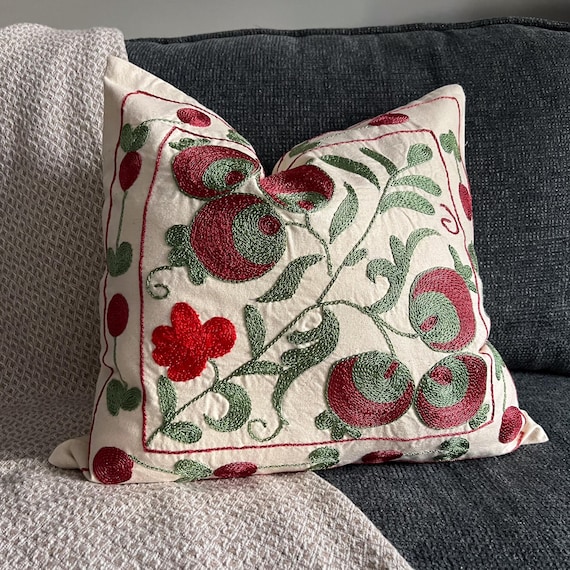
A suzani is something else entirely: a hand-embroidered textile from Uzbekistan and the broader Central Asian region. It starts with a base fabric — typically cotton or linen — onto which silk or cotton thread is stitched by hand, historically as part of a bride's dowry, worked on by the bride and her female relatives over months or years before a wedding.
Where kilim motifs are geometric and built into the weave, suzani motifs are embroidered on top of the base cloth and are almost always floral or celestial: pomegranates, tulips, vines, and sun or moon disks, each traditionally carrying its own symbolism around fertility, protection, and abundance. The result is a textile with much softer, more organic linework than a kilim, and typically far more color variation within a single piece.
Quick Comparison
| Kilim | Suzani | |
|---|---|---|
| Origin | Türkiye / Anatolia | Uzbekistan / Central Asia |
| Technique | Flatwoven on a loom | Hand embroidered onto a base fabric |
| Materials | Hand-spun wool | Silk or cotton thread on cotton/linen base |
| Motifs | Geometric — diamonds, medallions, borders | Floral & celestial — pomegranates, vines, sun disks |
| Traditional use | Floor coverings, tent dividers, saddle bags | Bridal dowry textiles, wall hangings, bedding |
| Common today as | Rugs, pillow covers | Pillow covers, wall art, table runners |
How to Spot an Authentic Vintage Piece
This matters because the market is full of "kilim-style" and "suzani-style" reproductions — often machine-made, sometimes even printed — that borrow the look without the history. A few things to check:
- Irregularity is a good sign. Hand-woven and hand-embroidered pieces have small inconsistencies — a slightly uneven repeat, a stitch that varies in length. Perfectly uniform patterns usually mean machine production.
- Natural color variation. Vintage pieces dyed with natural or early synthetic dyes show subtle shifts in saturation across the piece. Flat, uniform color across the entire textile is a flag for a modern reproduction.
- Wear consistent with age. Genuine vintage pieces show wear patterns — slight fading, soft creasing — that make sense for an object that's actually decades old, not artificially distressed in a factory.
- Reverse side details. On a kilim, the back should look nearly identical to the front (that's the nature of flat weaving). On a suzani, you should be able to see the individual hand stitches on the reverse.
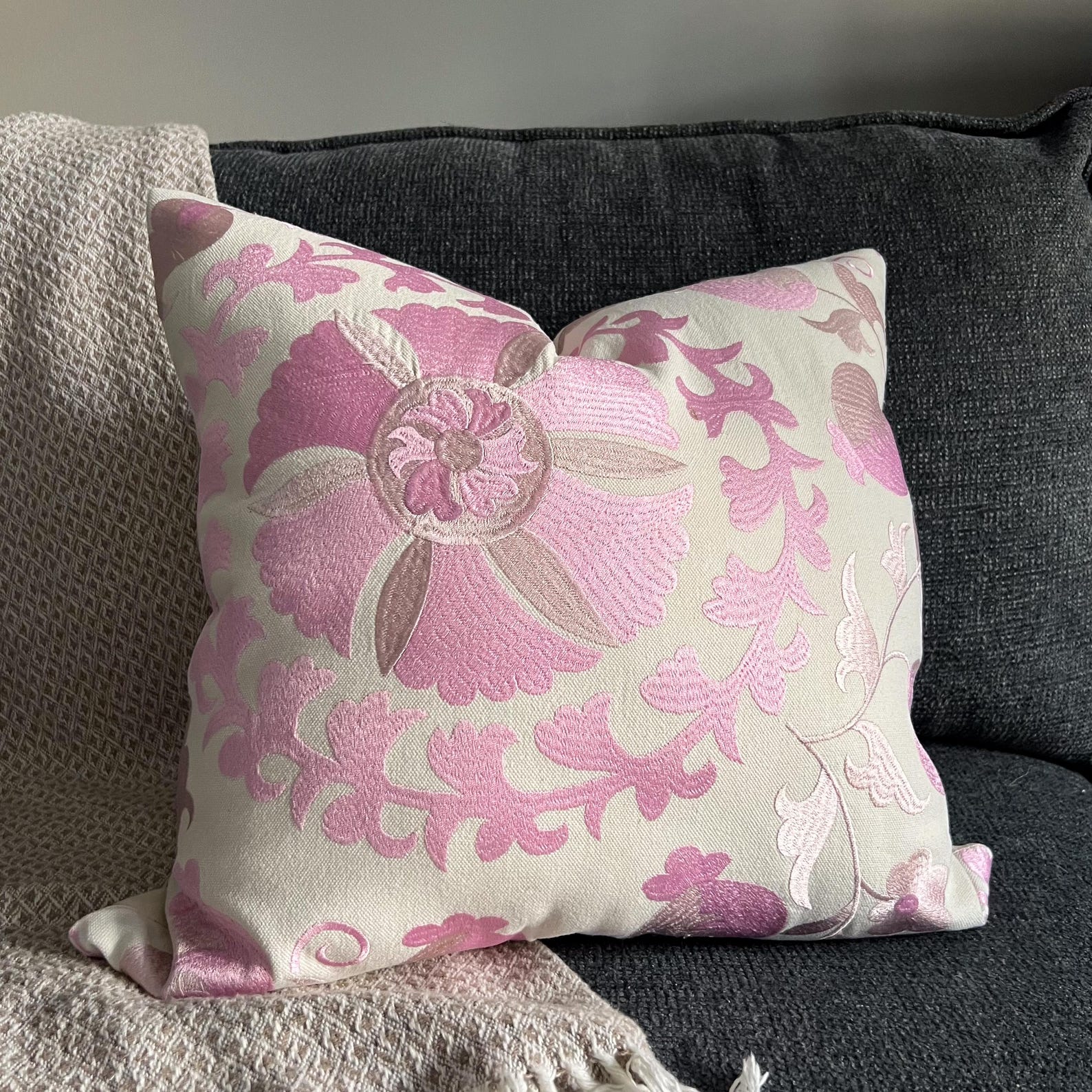
Hand embroidery has a rhythm and irregularity machine embroidery doesn't replicate.
What to Look For Before You Buy
A quick pre-purchase checklist
- Condition: ask about any holes, repairs, or areas of heavier wear before you buy
- Size for purpose: a kilim fragment cut for an 18x18" pillow cover reads very differently than the same motif on a large area rug — think about scale in your space
- Color fastness: ask the seller whether natural or synthetic dyes were used, especially for pieces that will get direct sunlight
- Sourcing transparency: a seller who can tell you roughly where and how a piece was sourced is a good sign you're buying the real thing
Every kilim, rug, and suzani piece we list includes honest photos of the actual item and its condition — because with vintage textiles, what you see is genuinely what you get, and that's exactly the point.
— The bkCAMUR Home team, Philadelphia
See the difference for yourself
Browse our current kilim pillow covers, rugs, and suzani textiles — all one of a kind, all shipped free across the continental US.
Shop the Collection