Frequently Asked Questions
Sizing, care, shipping and everything else people ask before buying a textile that only exists once. If your question is not here, send it over.
One of a kind
Free US shipping
Retail & trade
Sizing, care, shipping and everything else people ask before buying a textile that only exists once. If your question is not here, send it over.
A kilim is woven; a suzani is embroidered. Kilims come from Türkiye and the wider Anatolian region, made on a loom in wool, with the pattern built into the structure of the cloth. Suzani comes from Uzbekistan and Central Asia: silk thread stitched by hand onto a woven cotton ground. They are different materials, different techniques and different countries, and the two get conflated constantly in the resale market.
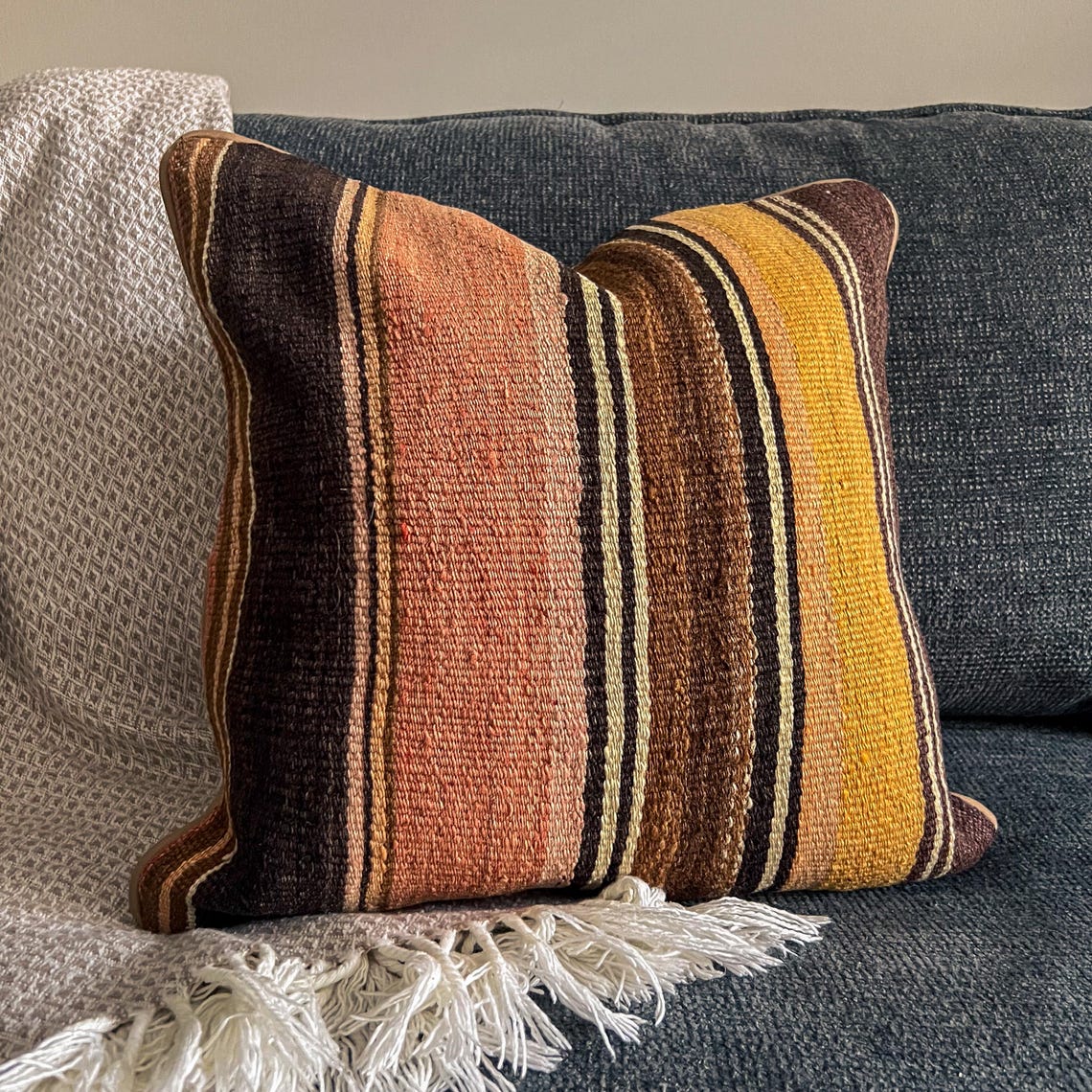
Vintage and antique, with a small number of newly-made suzani covers. Rugs and kilims are bought whole and secondhand, most of them decades old. Kilim pillow covers are cut from antique flatweaves that had reached the end of their life as floor pieces. Each listing says what a piece is and roughly how old it is.
Almost always, yes. A pillow cover is cut from one specific textile, and that textile yields what it yields — often a single sound panel, sometimes two or three. When a listing sells there is no reorder. A handful of listings have a quantity above one, and those say so on the card.
No, covers are sold without inserts. Size the insert about an inch larger than the cover for a filled look rather than a slumped one — a 19″ insert in an 18″ cover. Feather-down collapses nicely into the corners; a polyester insert holds a squarer shoulder.
Spot clean with cold water and a wool-safe or colourless soap, blotting rather than rubbing. Do not machine wash: the wool or the cotton ground will shrink unevenly and the piece will not recover. For a full clean, use a dry cleaner who has handled antique textiles before.
Naturally dyed wool ages by softening rather than going grey, and most pieces here have already been through decades of that. Silk embroidery is more light-sensitive than wool, so keep suzani out of unshaded direct sun and rotate covers seasonally if they sit in a bright window.
Shipping is free within the United States on every piece. Orders are fulfilled through our Etsy shop, so checkout, tracking and delivery estimates all run through Etsy at the point of purchase.
Some listings ship outside the United States and some do not, depending on the size and weight of the piece. The shipping options for any given item are shown on its Etsy listing. If you do not see your country, message us and we will look into it.
Returns are handled under the policy shown on each Etsy listing. Because these are one-of-a-kind secondhand textiles, we would much rather answer questions before you buy — ask for extra photographs, measurements or a closer look at a repair and we will send them.
Usually it is age, and we photograph it deliberately. Fading on one side, a small old repair, or a seam where the weaver joined two loom widths are all normal in a textile this old, and they are described in the listing. Anything that affects how a piece can be used is called out explicitly.
Yes. Every category is available at trade pricing for interior designers, boutique retailers and volume buyers, with line sheets and sample terms on request. See the trade and wholesale page.
That is what our custom sourcing service is for. Send the size, palette and budget you are working to, and we start hunting straight away. There is no obligation — if we cannot find it, you owe nothing.
Philadelphia, Pennsylvania — and Istanbul. Our father does the buying from there; his daughter and son run everything else from the States. We do pop-up markets and design fairs locally, so if you are nearby and want to see a piece in daylight before buying, say so and we will work something out.
Daily. The pieces shown on the category pages are pulled straight from our Etsy shop once a day, so what you see is what is genuinely still available.
Still deciding between the two traditions? The kilim vs suzani guide compares them properly, or start browsing suzani, kilim pillow covers or rugs and kilims.