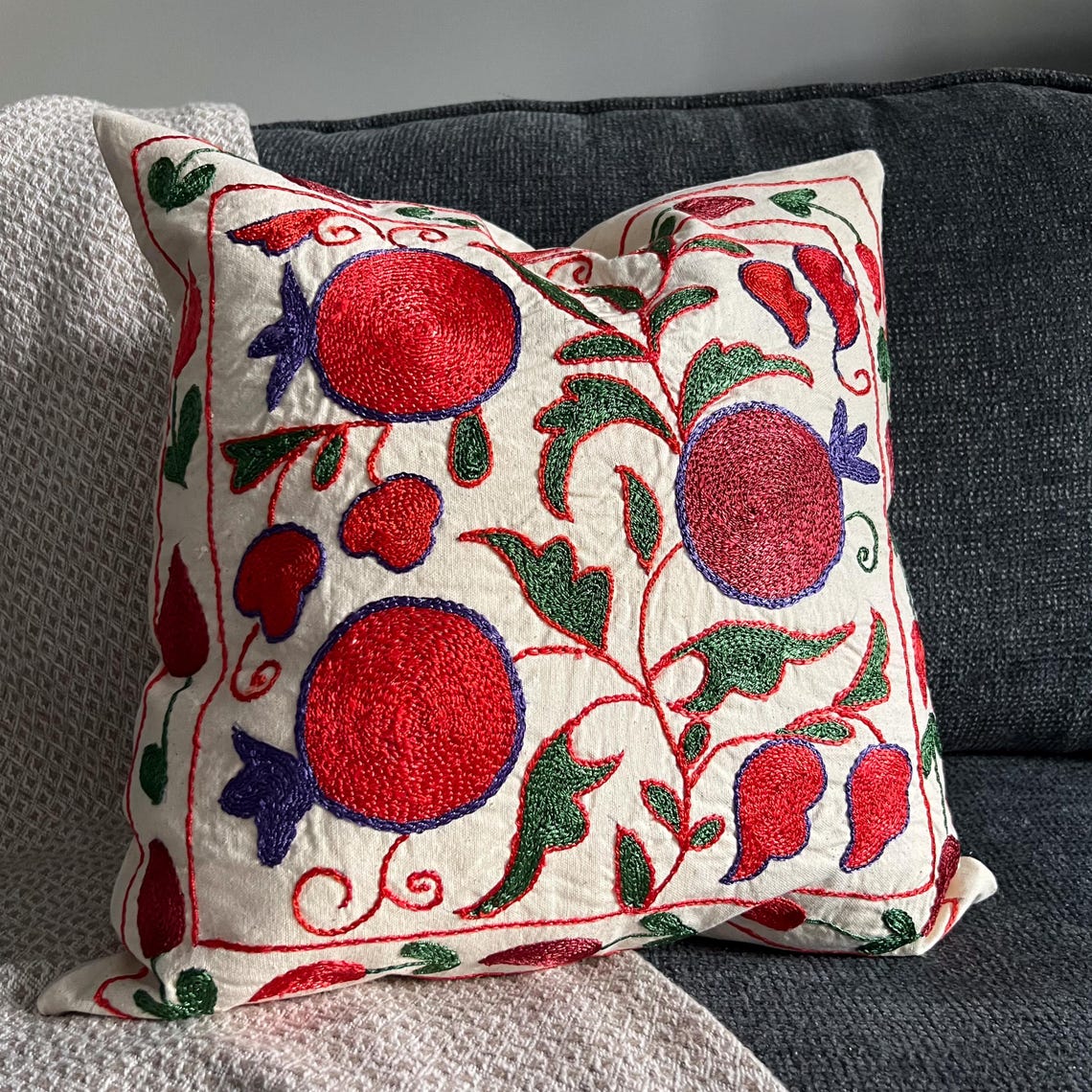
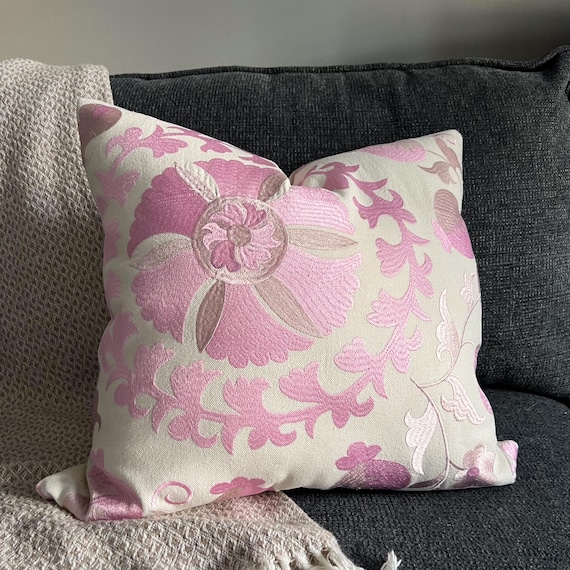
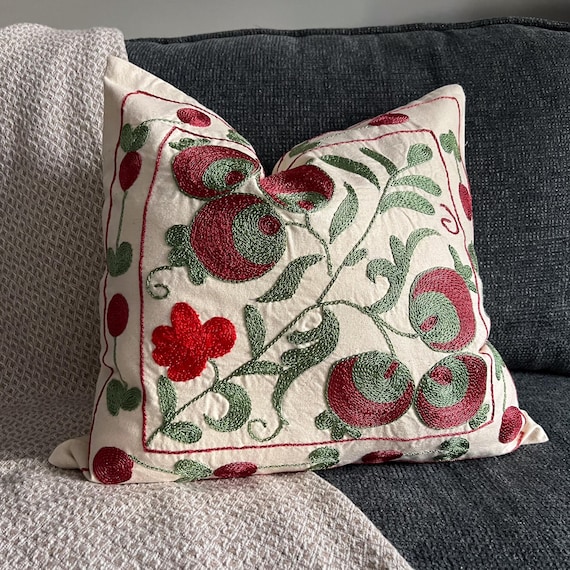
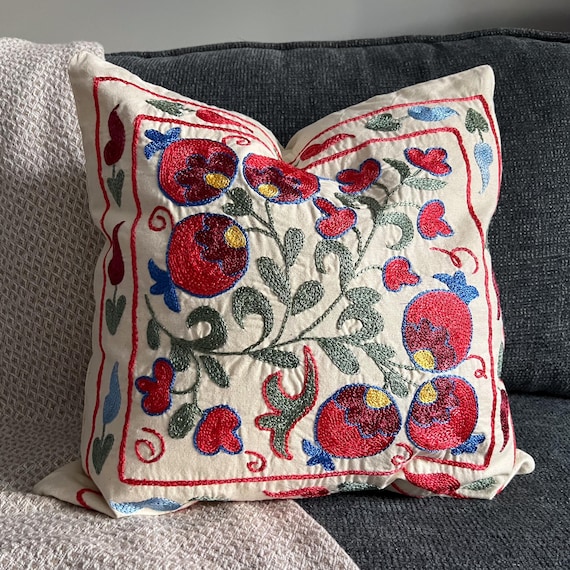
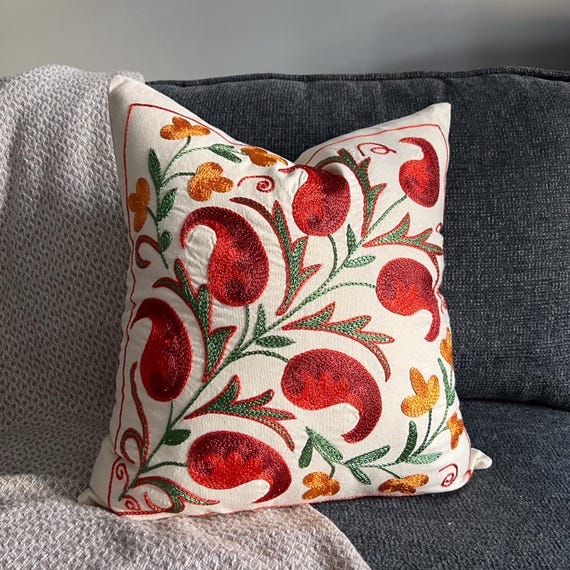
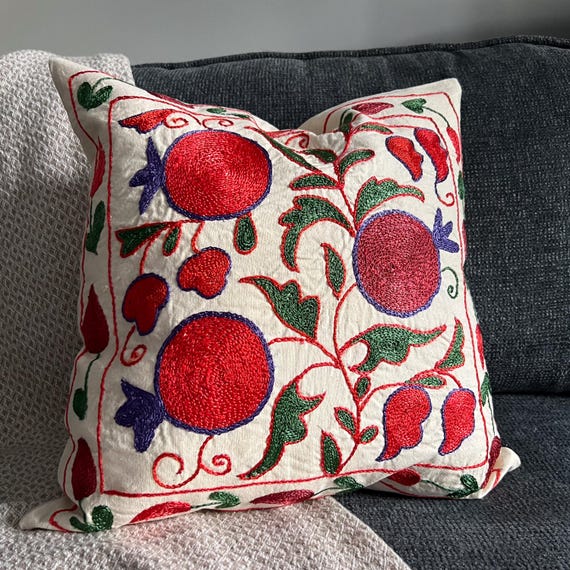
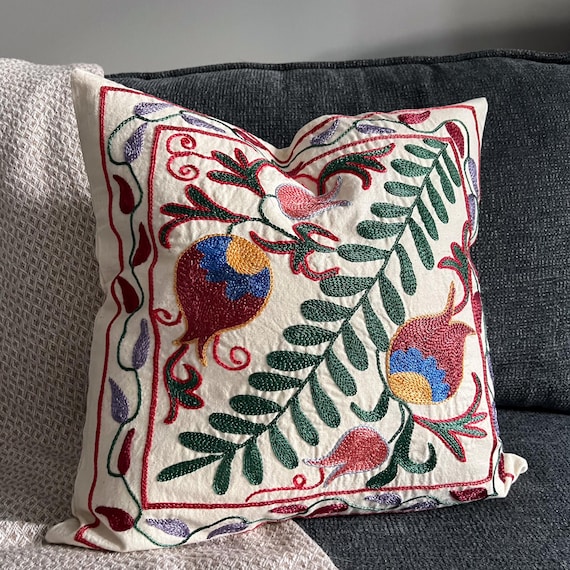
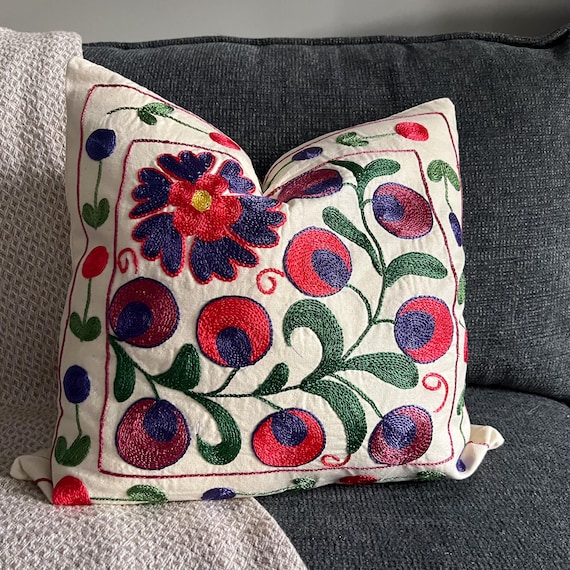
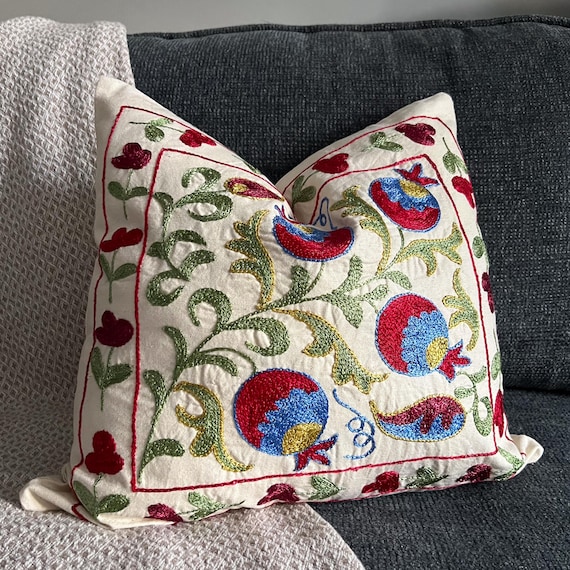
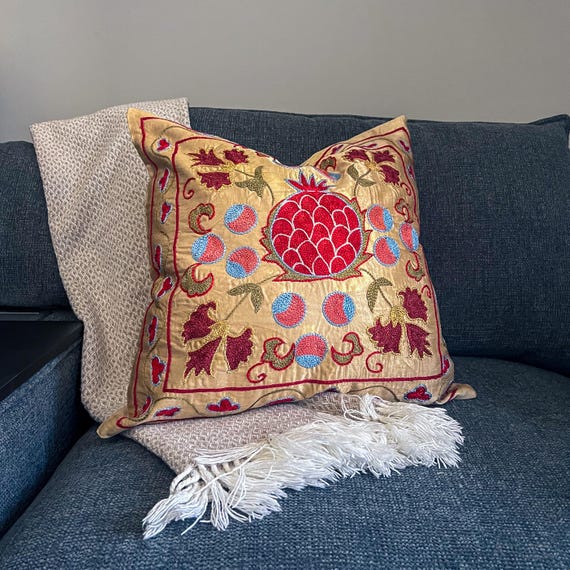
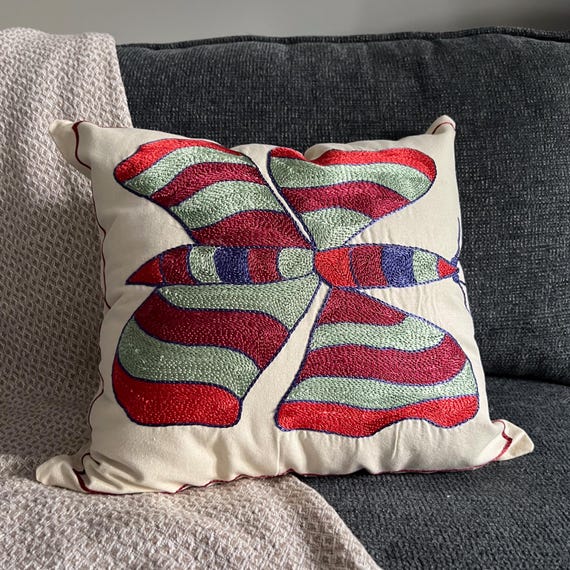
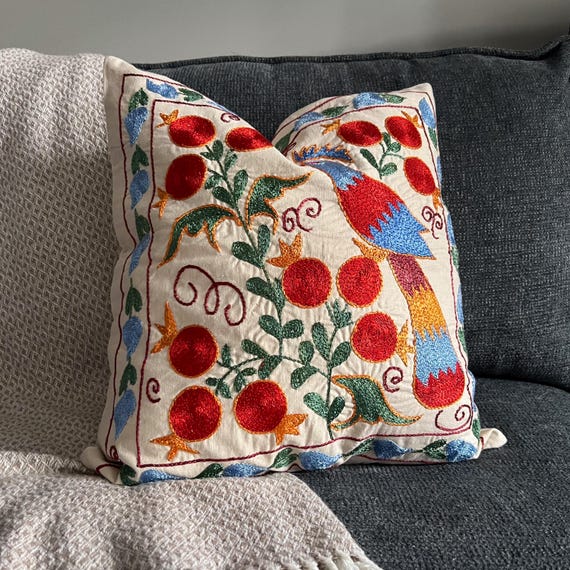
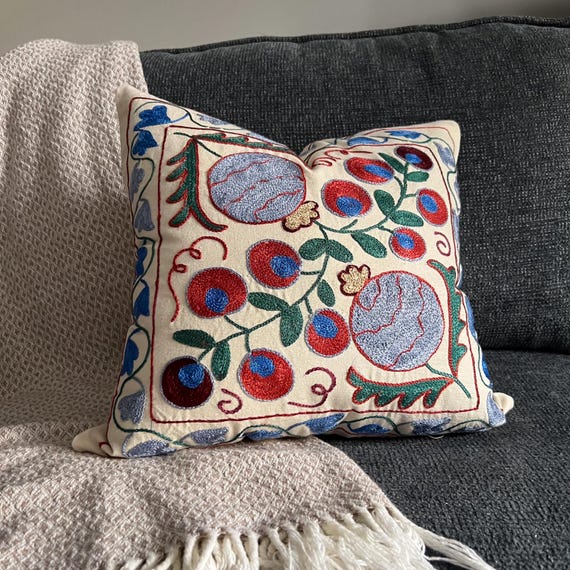
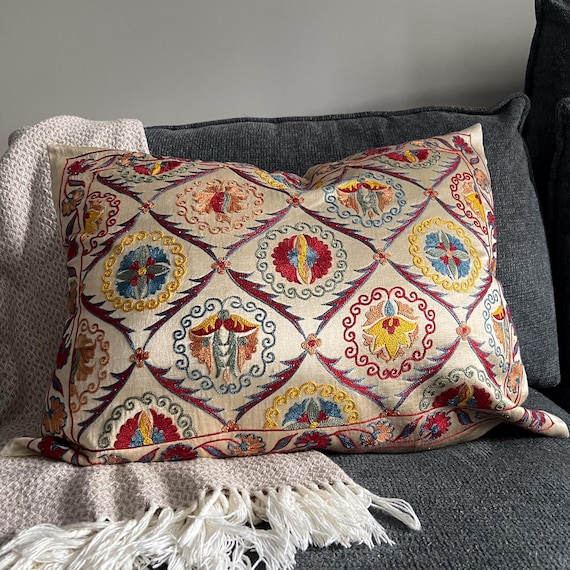
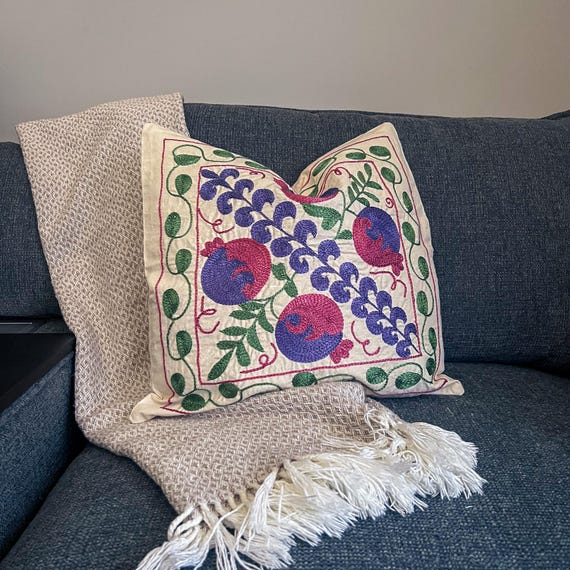
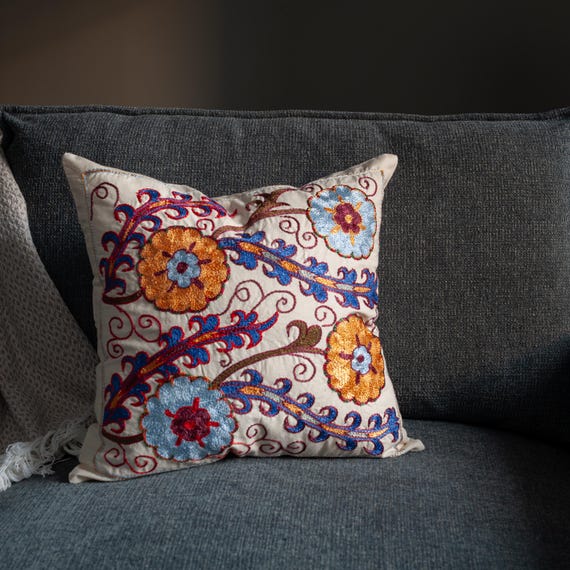
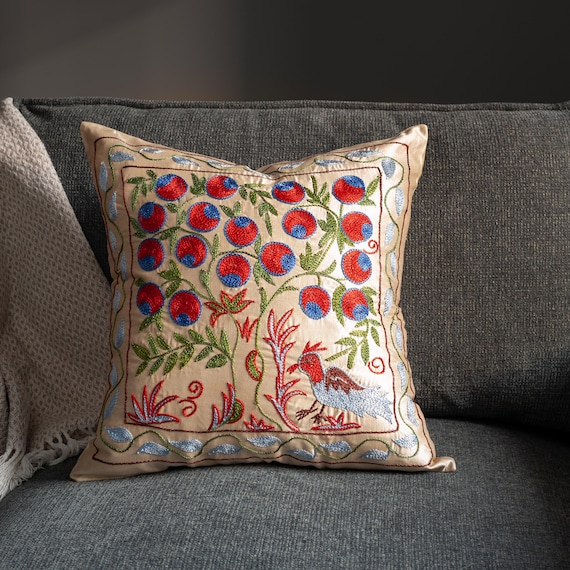
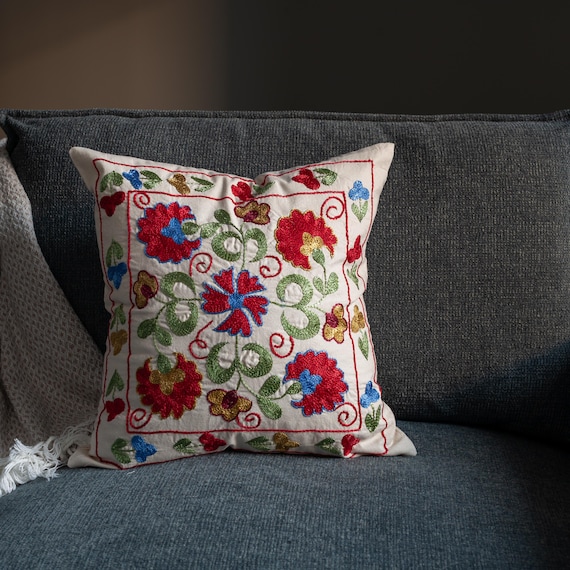
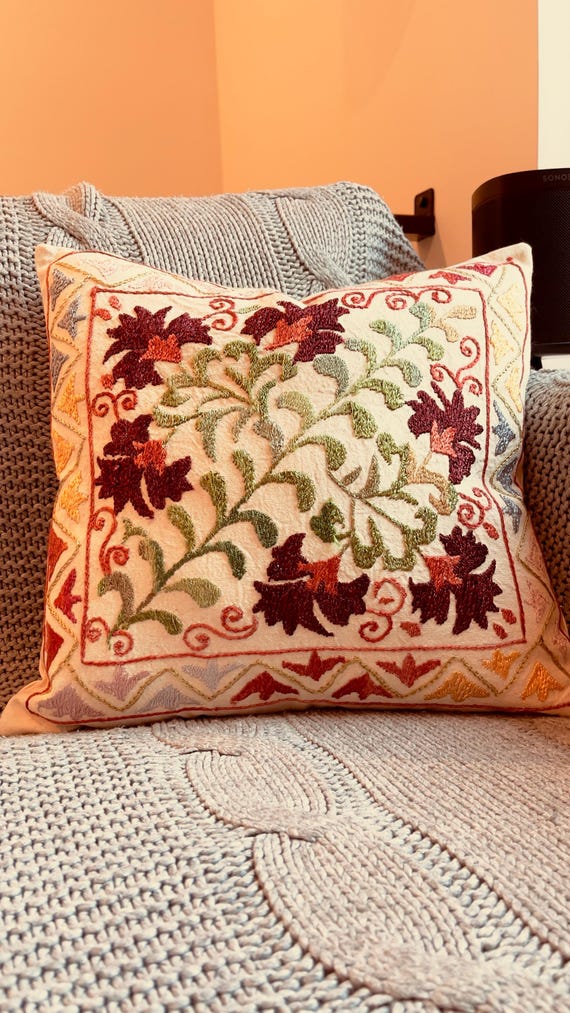
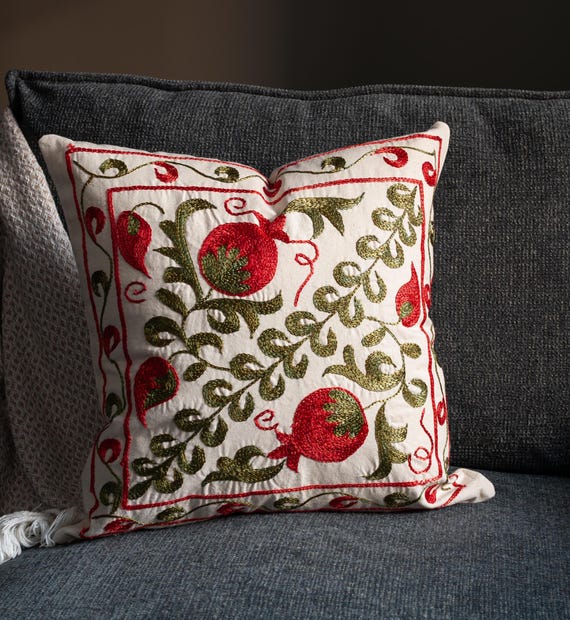
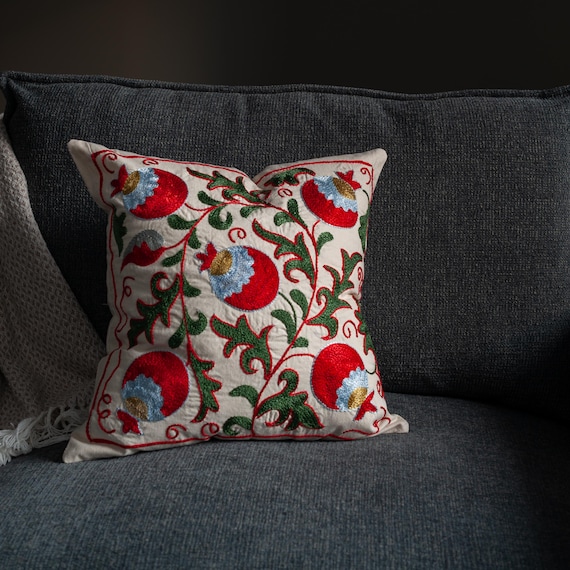
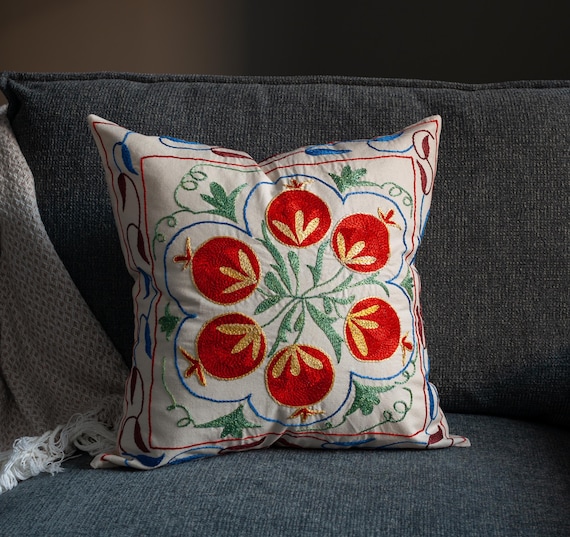
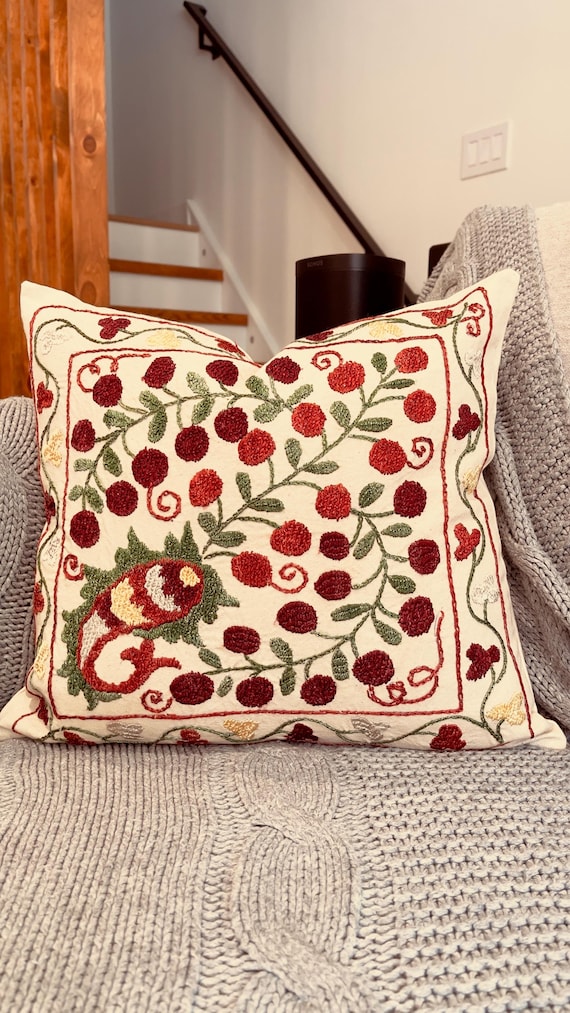
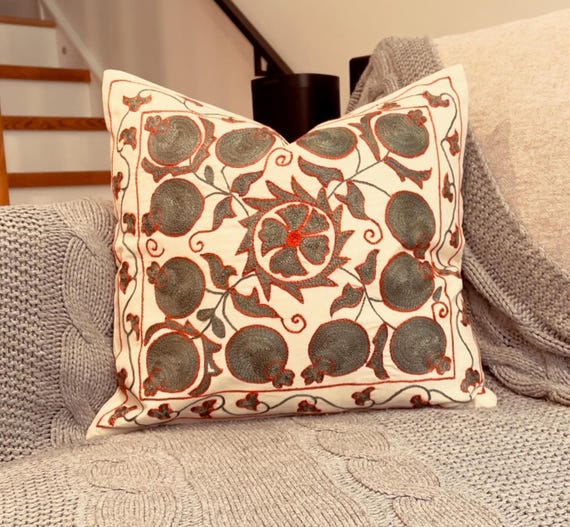
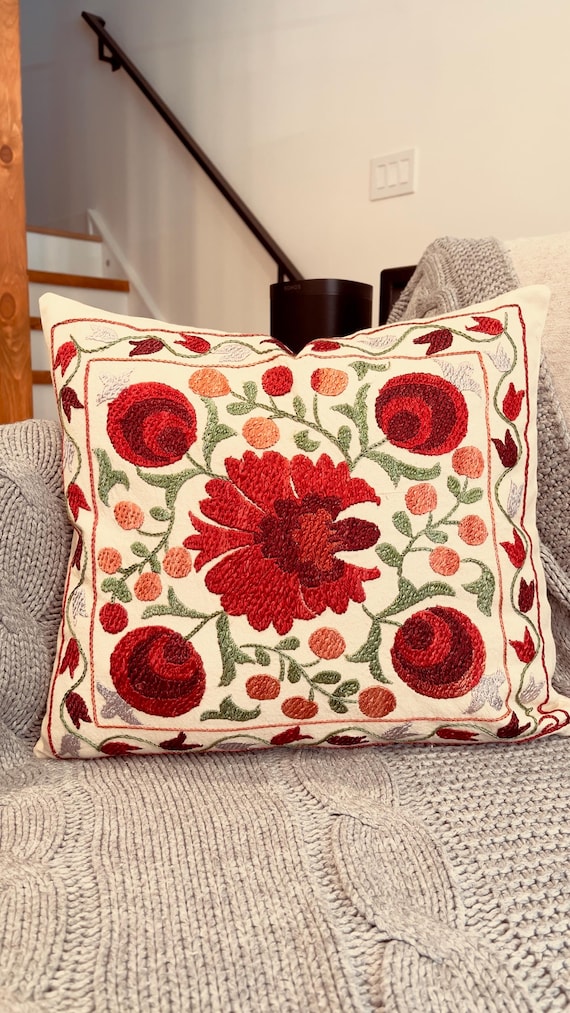
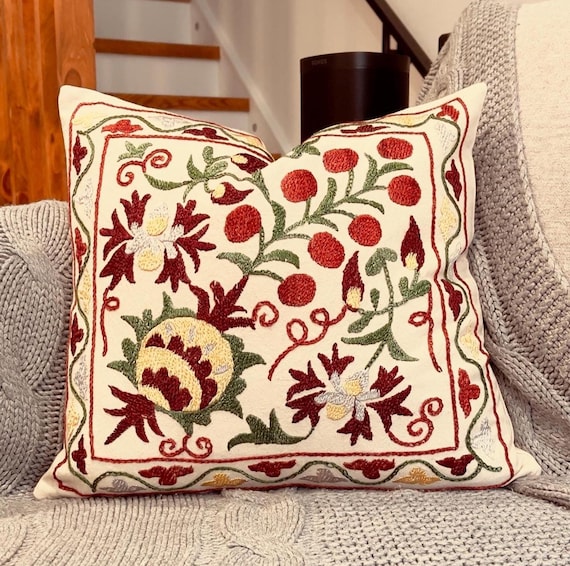
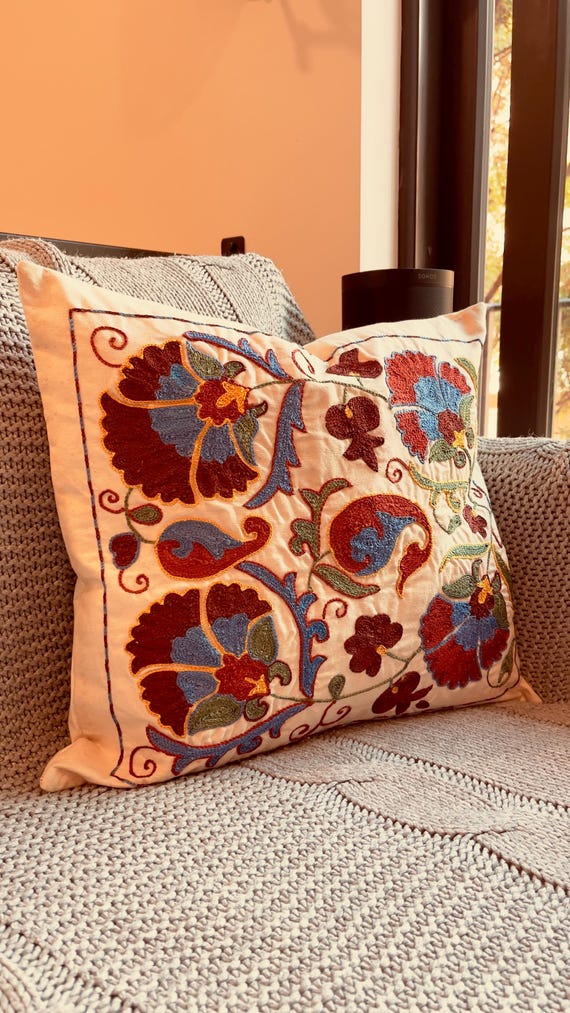
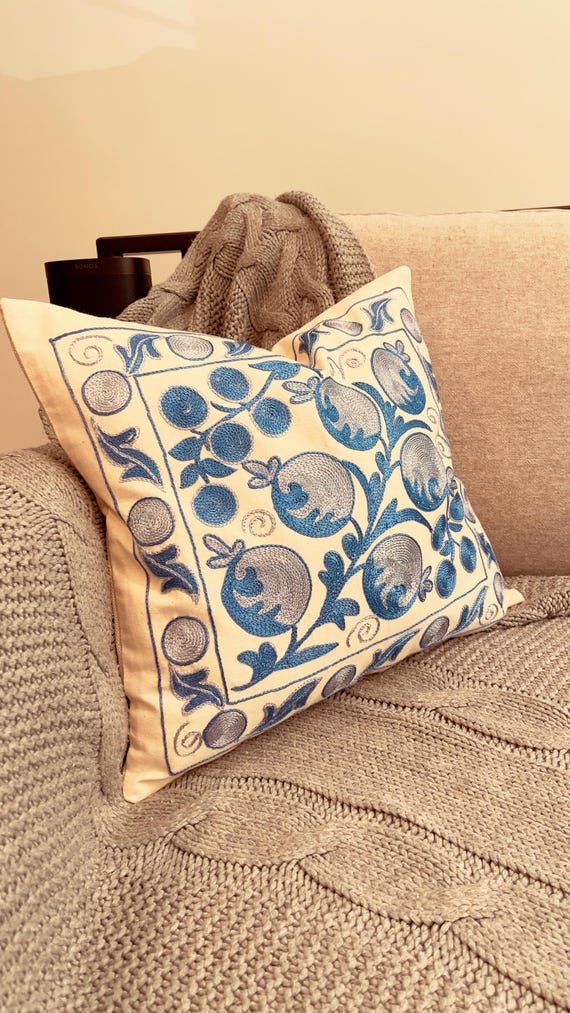
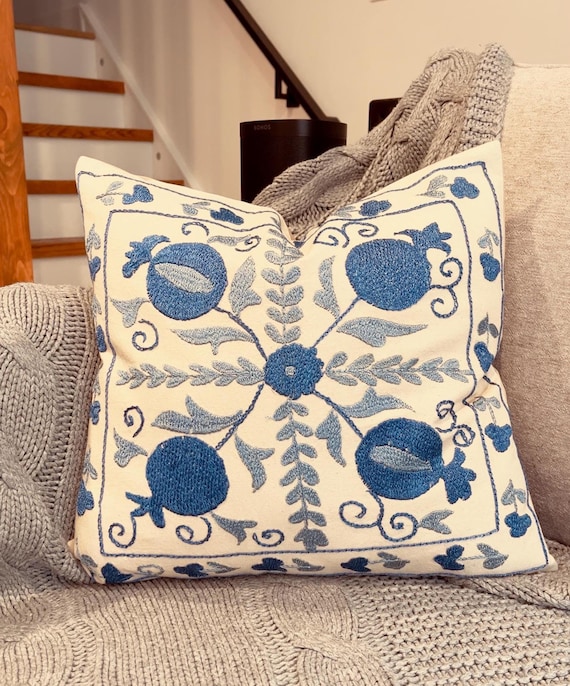
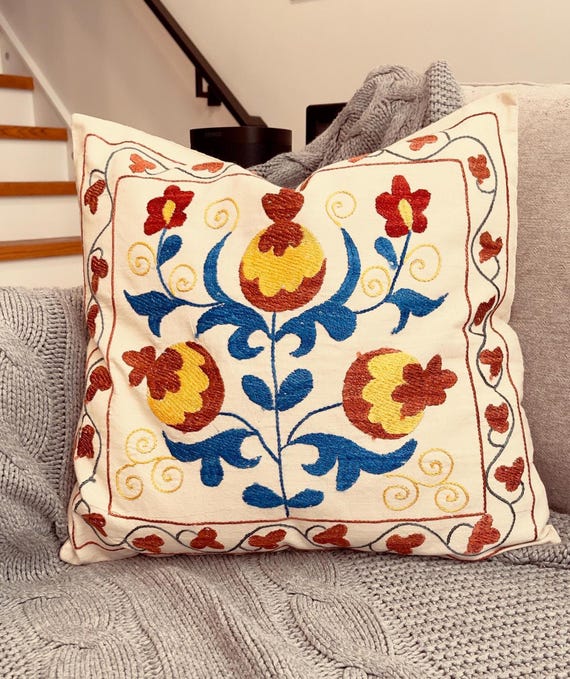
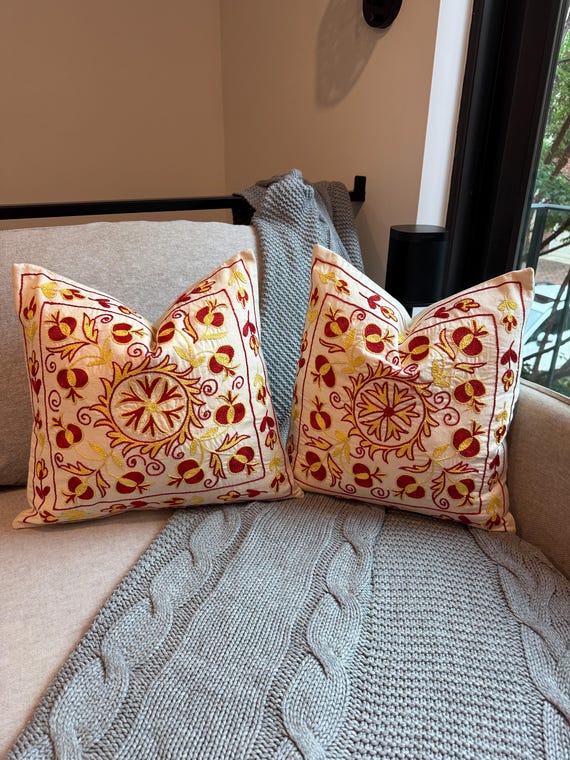
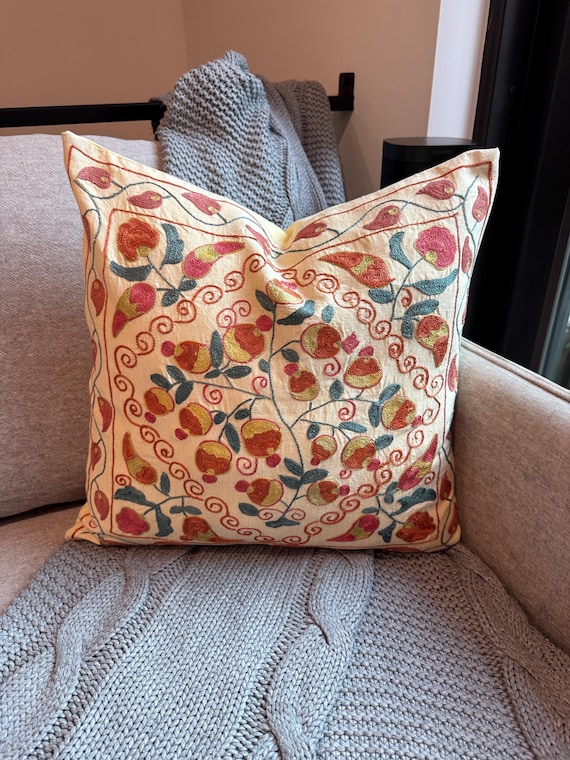
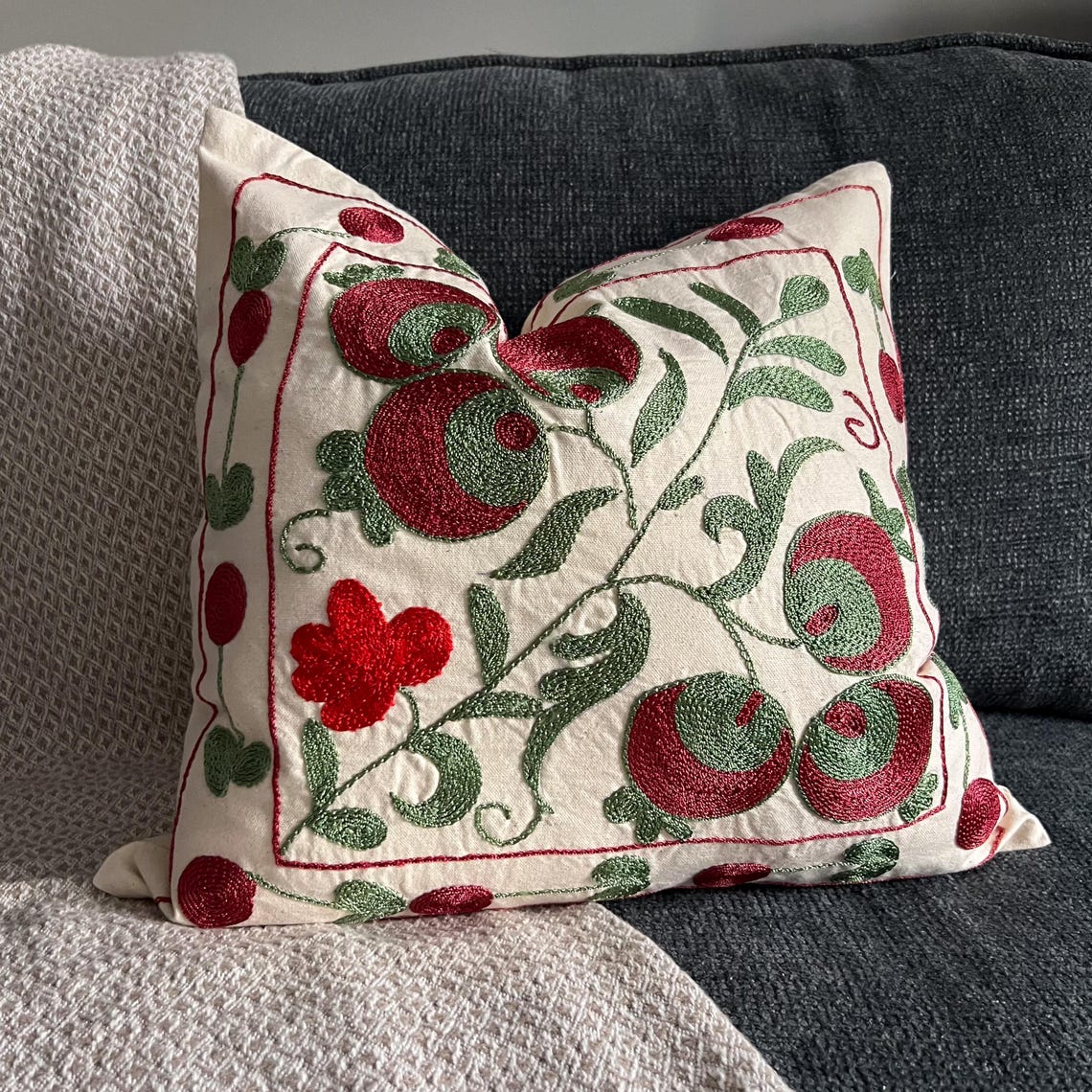
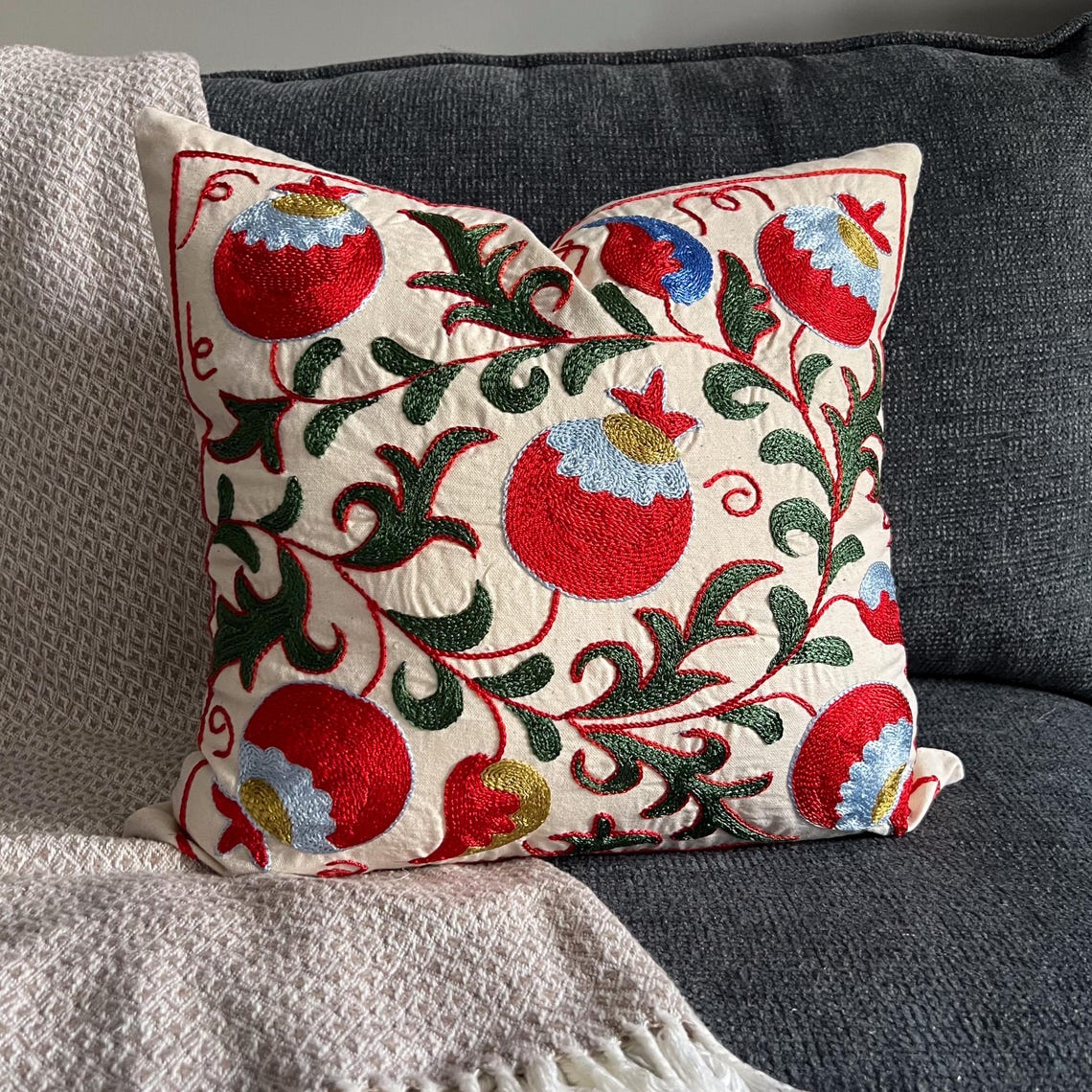
Silk thread worked by hand onto loomed cotton, in Uzbekistan, by women who learned the stitches from their mothers. Every cover on this page is cut from a distinct textile, so no two are alike — and once one sells, that exact piece is gone.
UzbekistanSilk on cotton17″–20″Free US shipping
The Collection
Available Suzani Pillow Covers
Uzbekistan · Silk Thread
1 of 1 Available
Suzani Pillow Cover 18x18 Soft Pink Floral, Hand Embroidered Uzbek Silk Cushion, Pastel Boho Decor
Every suzani above is pulled automatically from our Etsy shop and kept in sync daily. Checkout and shipping are handled by Etsy.
The Detail
About suzani pillow covers
What suzani actually is
Suzani comes from the Persian suzan, meaning needle. The word describes a technique rather than a single object: dense floral and celestial embroidery, worked in floss silk on a cotton ground, produced across Uzbekistan, Tajikistan and the surrounding region for centuries. What reads at a distance as one continuous field is usually several narrow panels, each embroidered separately and joined once finished.
That construction is a clue to how these were made. A bride's family would divide the drawn design between mothers, aunts and neighbours, each taking a strip. Slight shifts in tension, in the exact red one woman had to hand, in how tightly a chain stitch was pulled — those variations survive in the finished cloth. Held up to light you can often still see where one panel ends and the next begins.
The dowry tradition
Suzani were dowry textiles. Work began years before a daughter married, and the finished pieces travelled with her: hung behind the marriage bed, spread over a chest, wrapped around belongings for the journey. The motifs carried intent rather than decoration. Pomegranates for fertility, blooming rosettes for fortune, the repeating disc some scholars read as sun and others as moon. A scattering of the pieces we source still carry a deliberate irregularity in the border — a stitch dropped on purpose, on the belief that only God finishes anything perfectly.
Floss silk worked over a narrow-loomed cotton ground — the sheen shifts with the angle you stand at.
Silk thread on hand-loomed cotton
The ground cloth is cotton, narrow-loomed, which is why the panels are the width they are. The embroidery itself is floss silk, largely in chain stitch and the couched basma stitch that lets a maker fill a large petal quickly while keeping the surface glossy. Silk is what gives a suzani its particular behaviour in a room: the colour shifts as you cross in front of it, because the untwisted floss throws light in one direction and absorbs it in the other. A photograph flattens this almost entirely. It is the main reason these pieces look better in person than on a screen.
Older embroidery was dyed with madder, indigo, pomegranate rind and larkspur. Those dyes soften rather than fade, which is why a well-kept vintage suzani reads warmer than a new one.
Sizes and finishing
We cut covers to sit in the range most sofas and beds actually want, and finish each with a concealed zip and a plain cotton back so the embroidery is the only thing doing any work.
Size
Where it tends to land
17″ × 17″
Armchairs, reading chairs, the outer corners of a deep sofa
18″ × 18″
The common one — standard sofa cushions, bed fronts
20″ × 20″
Sectionals, low daybeds, floor seating
Inserts are not included. For a filled look rather than a slumped one, size the insert an inch over the cover — a 19″ insert in an 18″ cover. Feather-down collapses into the corners best; a poly insert holds a squarer shoulder if that is the look you want.
Two covers on a quiet sofa is close to foolproof: let the embroidery be the only loud thing in the room.
How to live with them
Suzani are loud, and that is the point. They work best when the room lets them be the only loud thing. Two on a linen sofa in oatmeal or putty, against plaster walls, is close to foolproof. Odd numbers read more relaxed than even ones.
Mixing more than one suzani is a matter of ground colour rather than motif — two pieces on the same cream ground will sit together happily even if one is all pomegranates and the other is discs. If you want to break up the embroidery, the flatweaves on our kilim pillow covers page give you geometry and wool texture against the silk, which is a far easier pairing than another embroidery.
Direct sun is the one real enemy. Silk floss is more light-sensitive than wool, and a cover left in an unshaded south window will show it within a season.
Care
Spot clean only, with cold water and a colourless soap. Blot; never rub, which will fuzz the floss.
No machine washing and no tumble drying — the cotton ground and the silk shrink at different rates.
Dry-clean only with someone who has handled antique textiles before.
Rotate covers seasonally if they sit in strong light.
Air rather than store damp; if a cover has been boxed, let it breathe flat for a day before use.
New to these textiles? Our kilim vs suzani guide lays out how the two traditions differ in material, technique and origin — useful if you are deciding which suits a room before you buy.
Why each one is the only one
We buy finished vintage and antique suzani, not yardage, and cut covers from what a given textile can honestly yield. A panel with a strong central rosette becomes one cover; the border might make a second. When those are sold, there is no reorder — the source textile is used up. What you see on this page is the actual, current inventory, pulled directly from our Etsy shop and refreshed daily, so nothing here is listed that we cannot ship.